
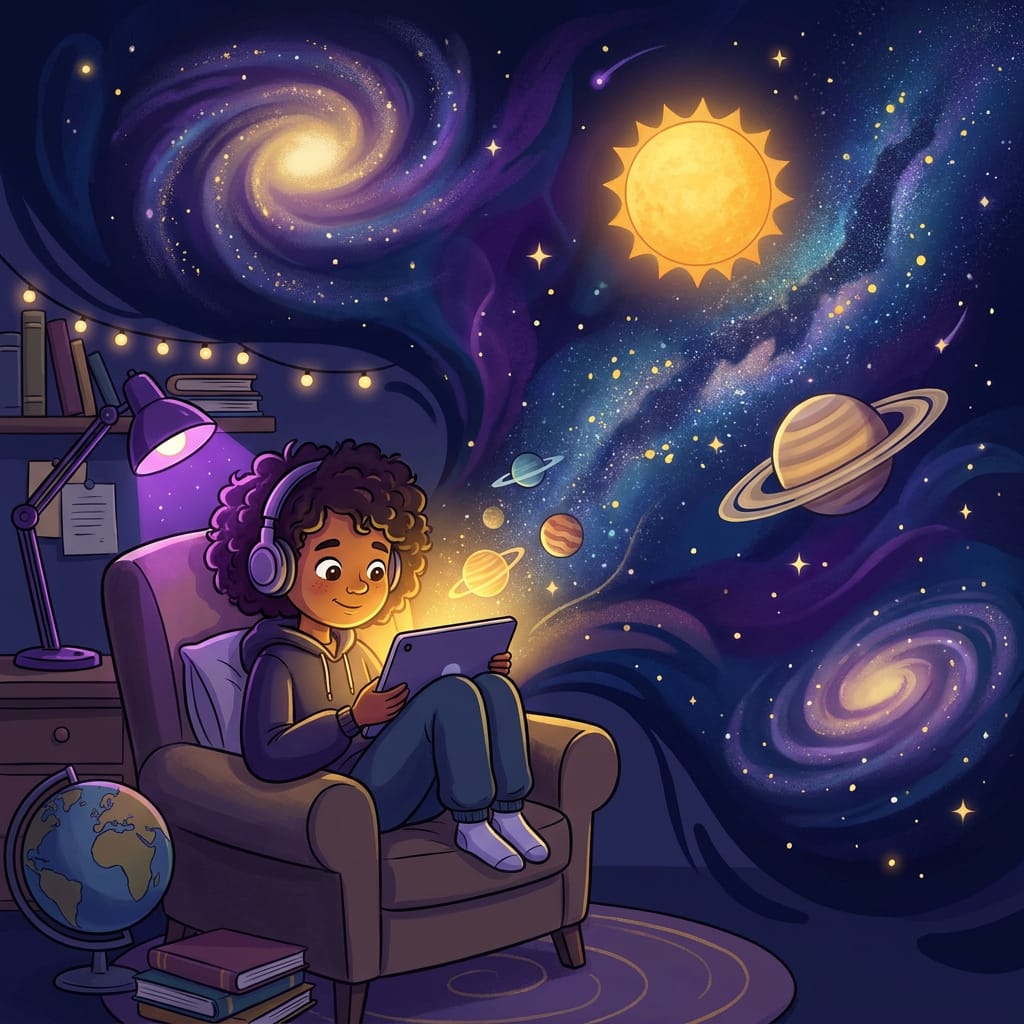
For centuries, space has fascinated people. From the glowing Moon we see at night to the colorful images of distant planets captured by NASA, the solar system continues to inspire curiosity in children and adults alike. For young learners, understanding the planets is not just about memorizing facts, it is about discovering our place in the universe and developing a life long interest in science. At Web3sy, we believe learning should be engaging, visual and enjoyable. That is why we created our Solar System – Poster & Fun Fact Resource Pack, designed to introduce children aged 8-15 to the incredible worlds that make up our cosmic neighborhood.
Why Learning About the Solar System Matters
Space science encourages children to ask questions, think critically, and explore subjects beyond the classroom. As they learn about the planets, children also develop a better understanding of Earth’s place in the universe and the unique conditions that make life possible. Topics such as planetary atmospheres, gravity, temperature and distance from the Sun introduce important scientific concepts in a way that sparks curiosity rather than overwhelming learners with technical information.
Whether a child dreams of becoming an astronaut or simply enjoys learning new facts, studying the solar system helps build confidence in STEM subjects and encourages independent discovery.
Explore the Planets
Traditional science textbooks can sometimes feel overwhelming, especially for younger learners. Our Solar System – Poster & Fun Fact Resource Pack uses colorful illustrations, friendly planet characters and bite sized facts to make learning more approachable. Each planet is presented with easy to understand information about its size, atmosphere and unique characteristics, helping children remember key facts through engaging visuals rather than lengthy explanations. From the smallest rocky worlds to the enormous gas giants, every planet has its own fascinating story.
The resource begins with an overview of our solar system before taking learners on a journey across each planet. Children discover that the Sun is approximately 109 times wider than Earth, with surface temperatures reaching around 5,500°C, making it the powerful star that supports all life within our solar system.
They then meet Mercury, the smallest planet, before traveling to Earth, our home, and Mrs, famous for its distinctive red surface and frozen polar ice caps. The adventure continues with Venus, where thick carbon dioxide clouds tap incredible heat, and Saturn, instantly recognisable thanks to its spectacular ring system.
Finally, learners explore the distant ice giants Uranus and Neptune, discovering their striking blue colors, methane rich atmospheres and some of the strongest winds found anywhere in the solar system. By presenting each world individually, children can easily compare the planets while building a clear understanding of how different they really are.
Designs for Home and Classroom Learning
Whether you are a parent supporting learning at home or an educator looking for engineering classroom resources, this digital pack has been designed with flexibility in mind. It works well as a lesson companion, revision aid, independent learning activity or even as colorful posters displayed in classrooms or study spaces. Because the information is broken into manageable sections, children can explore the resource at their own pace while building confidence in science.
The Solar System – Poster & Fun Fact Resource Pack has been created for children aged 8-15, making it suitable for upper primary and secondary learners. It is ideal for:
- Parents encouraging a love of science at home
- Teachers looking for engaging classroom resources.
- Homeschooling families.
- Young space enthusiasts who enjoy discovering how the universe works.
Its colorful design also makes it an excellent conversation starter, encouraging children to ask questions and continue exploring beyond the resource itself.
Research consistently shows that children retain information more effectively when it’s presented visually alongside concise explanations. Rather than overwhelming learners with dense paragraphs, combining illustrations with memorable facts helps improve understanding and recall. Our illustrated planet characters transform complex scientific information into something approachable, making space science feel exciting rather than intimidating.
Inspire the Next Generation of Explorers
Every great scientist starts with curiosity. Whether it’s wondering why Saturn has rings, why Mars appears red, or how enormous the Sun really is, these simple questions often become the beginning of a lifelong passion for learning.
The Solar System – Poster & Fun Fact Resource Pack helps nurture that curiosity by making planetary science fun, memorable, and accessible for children aged 8-15. Through colourful illustrations, easy-to-understand facts, and engaging visual design, it’s a resource that encourages young learners to explore the universe with confidence.